"HAIDA
SPIRIT" |
|
350 s/n Paper Giclee
26 5/8" x 19"
$2399
180 S/N Canvas Giclee
24" x 34" $995 |
"On
a visit to the Queen Charlotte Islands, a Haida elder guided
my wife, Birgit, and me to a secluded spot on a peaceful bay.
There, Bill Reid’s canoe sat at a lonely anchorage. It was Reid
who directed the hollowing of the 50-foot canoe from a single
ancient red cedar according to traditional Haida designs, following
their traditional method. The canoe was the first of its kind
in almost one hundred years. Powered by 20 Haida paddlers, it
made an epic 558-mile journey from Vancouver to Skidegate and
truly earned its name, Loo Taa (Wave Eater). Seeing the canoe
was, for me, a kind of spiritual experience. And although there
was no raven present on that day, in my mind’s eye, I saw one.
To the Haida, the raven is a wily trickster-transformer who
created the world, and I could see him, hovering over the canoe,
perfectly centered." Robert Bateman |
"HARLEQUIN
DUCK - BULL KELP" - EXECUTIVE EDITION
Washington Duck Stamp Print - 1988 |

Paper |
|

Lithograph |
|
"HIGH
CAMP AT DUSK" |
|
950 s/n Paper
10 3/4" x 33 1/2"
$725 |
"We
had been riding steadily upward for three days. Our top camp was a beaver meadow - a lush, natural pasture
grown up on the silt deposited behind a long forgotten beaver
dam. It was the peak of a high country
summer, resplendent with flowers of many kinds. " Robert
Bateman |
"HIGH
KINGDOM" - SNOW LEOPARD |
|
10,772 s/n Paper
20" x 27 3/4"
$559
Canvas Giclee 225 S/N 28"X40" $1175
|
"Of
all the big cats, the snow leopard is perhaps the most endangered
species. Although it lives in one of
the wildest and least accessible parts of the world, the Himalayas,
it is very vulnerable." Robert Bateman |
"HOARY
MARMOT" |
|
450 s/n Paper
11 1/4" x 22 1/2"
$138 |
"On
a hike in Banff National Park quite a few years ago, my family
and I found ourselves alone on a high saddle where the mountain
dropped off sharply on either side. It
was one of those moments when the world stands still and all
your senses become heightened. The empty
space between us and the next mountain seemed almost a solid
presence, so vivid was my impression of the great gulf of air.
Then I saw a hoary marmot poised atop a nearby pile of rocks.
Despite its small size, it appeared to be lord and master of
the high peaks that stretched off in all directions. Quietly I began moving toward it. The
marmot remained motionless, allowing me to come so close I could
almost touch its beautiful mantle of silvery-white fur. My attention was so focused that I was only half-conscious
of a distant roaring sound - I dismissed it as a high-flying
jet plane - growing gradually louder. What happened next took
only a second or two, but it seemed to stretch out over a much
longer span. The marmot gave its characteristic
whistle and shot down its burrow. In
the split second I cursed my bad luck, the roaring sound became
so loud it seemed to come from inside my head. I looked up to
see a golden eagle plunging across the sky so close to me that
I felt the wind stirred by its dive. Then
it wheeled away and soared off in search of other prey."
Robert Bateman |
"HOUSE
FINCH AND ROSES" |
|
4500
s/n Paper
4 3/4" x 9 1/2"
$245 |
"The
house finch was originally found only in the southwestern United
States, where it nested in cactus and bushes. In the 1940’s
it was introduced to the east, where its range is now spreading.
Like all finches, it has a strong, stout, cone-shaped bill with
a sharp cutting edge—ideal for crushing seeds, which are its
principal food. Partly through the grace of home feeders, the
house finch, like the cardinal, has moved into urban areas,
where its cheery song, a high-pitched warble, has become a common
melody in city parks and gardens." Robert Bateman |
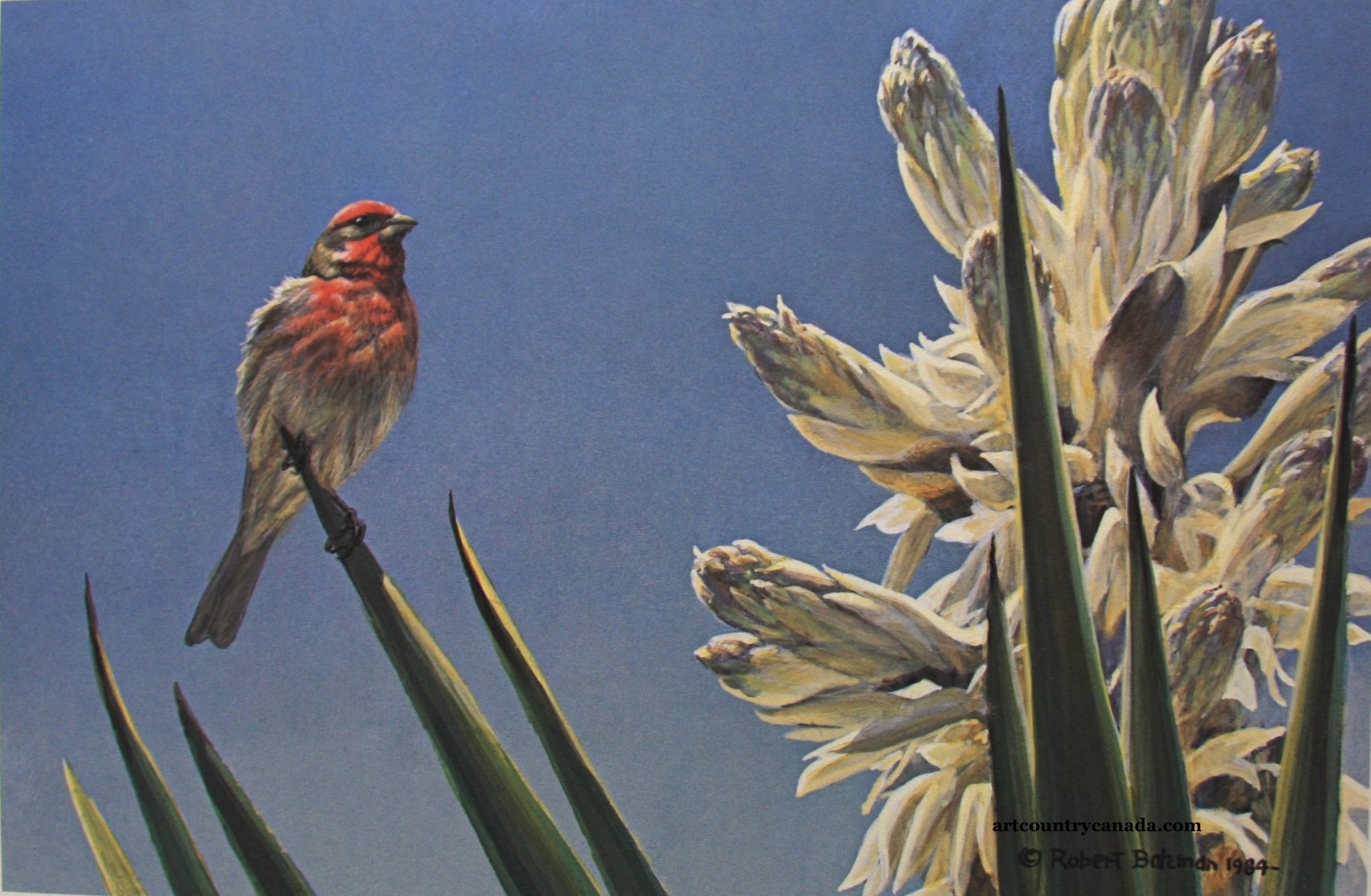
'HOUSE
FINCH AND YUCCA" |
|
950 s/n Paper Edition
7 1/2" x 10 7/8"
$438 |
"Many
times I have heard the lively warbling song of the house finch
and located the proud little male, announcing his territory
from the tip of a yucca spike." Robert Bateman |
HOUSE
SPARROWS & BITTERSWEET |
|
950 s/n Paper Edition
15 1/4" x 11 1/4"
$280 |
"In
this painting I have shown a group of house sparrows gathered
together for company during a cold winter’s night. The tangled bittersweet keeps its dried berries as a
winter decoration." Robert Bateman |
"HURRICANE
LAKE - WOOD DUCKS"
1987 Arkansas Duck Stamp Print |
|
8855 s/n Paper Edition
6.5" x 9"
$182 |
Robert
Bateman’s Hurricane Lake - Wood Ducks - Commissioned
by the state of Arkansas for the 1987 Migratory Waterfowl Stamp,
it is the first state print by an artist outside the USA. |
|
"HAIRY
WOODPECKER ON BIRCH" |
|
s/n Paper
11 7/8" x 17"
$99 |
Robert
Bateman |
"HARDWOOD
FOREST - WHITE-TAILED DEER" |
|
950
s/n Paper
19" x 32""
$2195 |
"The
white-tailed deer buck is in his prime. He
is looking for does with which to mate or other bucks with which
to fight. He is very cautious because
this is hunting season." Robert Bateman |
"HARLEQUIN
DUCK - BULL KELP"
Washington Duck Stamp Print - 1988 |
|
4595
s/n Paper
6.5" x 9"
$159 |
"One
of the oldest of the stock comic characters, the harlequin originated
in Italian popular comedy of the 16th century. The harlequin’s traditional fanciful costume is a multicolored
diamond pattern. This little duck is
something of a dandy and appropriately named. In the summer,
if you are lucky enough to see breeding pairs of harlequin ducks,
they may be found by cold, rushing mountain streams along which
they make their nests, well concealed under or in rock crevices." Robert
Bateman |
"HERON
ON THE ROCKS" |
|
|
"At
the bend in the river, the great blue heron rests on the rocky
point. It is a full-grown juvenile, wearing
a dusky cap instead of the white cap and the black cheek patch
of the adult. Even though he is now on
his own, he knows that this is a good place to fish." Robert
Bateman |
"HIGH
COUNTRY" - STONE SHEEP |
|
950
s/n Paper
18" x 24"
$520 |
"The
stone sheep is the southern and darker form of the Dall’s sheep. In this painting, I wanted to capture the breathtaking
majesty of the domain of the stone sheep and to give a feeling
of precariousness. They live in a world
of precipitous cliffs." Robert Bateman |
"HINDU
TEMPLE" - TIGER |
|
950 s/n
Paper Edition
16.25" x 32.5"
$315
180 s/n Canvas Giclee Edition
22" x 44"
$1495
|
"Secretive
and solitary, the endangered Bengal tiger still roams Northwest
India’s spectacular park, Ranthambhore. While
the tiger is not always easy to see in this region of mountainous
plateaus and rugged ravines, its presence can be felt: “While
exploring the ruins of the Hindu kingdom, we came upon a little
lake with a small temple perched perfectly on a peninsula. We were there at midday, but in my mind’s eye, I saw
it at dawn, or by moonlight, perhaps twilight. There could be a tiger, emerging from the shelter of
the temple, looking out over the lake.” Robert Bateman |
"HOMAGE
TO AHMED" |
|
|
"Thousands
of elephants have been slaughtered for trinkets - jewelry, piano
keys, and billiard balls - decorative items that sit on the
shelf or the mantel and collect dust. It
doesn’t seem to me to be a cause worthy of the destruction of
such a beautiful animal." Robert Bateman |
"HOODED
MERGANSERS IN WINTER" |
|
950 s/n Paper
22 " x 16 1/2"
$410 |
"In
many ways, the hooded merganser is one of the most elegant of
waterfowl. The striking black, white
and vermiculated rust gives it an almost exotic look. The silky crest and golden eyes increase the effect,
and yet it is a bird of very unexotic habitat - rather ordinary
swamps." Robert Bateman |
"HOUR
OF THE EGRET" |
|
1250 s/n Paper
15 1/2" x 20 5/8"
$144 |
After a long day, I generally take an evening walk. It was on one such stroll a few years ago that I came across the old Venice [FL] train station, abandoned and derelict. Its grandiose Romanesque arches are now defaced with graffiti and a superhighway roars overhead, but I like to imagine it in its heyday in the 1920's when trains were the only sensible way to travel long distances. Egrets regularly feed in a canal that runs nearby, and I recalled that these birds were once as endangered as the passenger train is today. In the nineteenth century, they were brutally hunted for their plumes, which were much coveted for fashionable ladies' hats. Sometimes the hunters would rip the plumes out of a living bird and leave it to a slow and agonizing death. In fact, the creation of the Audubon Society was spurred by a group of blue-blooded Boston ladies who were outraged by this barbaric practice. Thus the egret in my painting of the train station faces north, toward Boston, the birthplace of one of the great forces for wildlife conservation in North America.
|
"HOUSE
SPARROW" |
|
950 s/n Paper Edition
14 1/2" x 10 1/2"
$210 |
"I
have shown this cocky little male house sparrow on a traditional
farm fence. In many ways, he has a lot
in common with the settlers who took over North America and
pushed out the native inhabitants." Robert Bateman |
"HUMMINGBIRD
PAIR" DIPTYCH |
|
|
950
s/n Paper Edition
10 3/4" x 10 1/2"
$785 |
"I
have shown this pair as a diptych. The
idea came from Japanese screens, which have almost an arbitrary
breaking of a continuous scene. This
somehow forces the viewer to see the scene in a fresh way and
gives the composition an alternative significance. I was conscious of the parallel between the almost stained
glass glow of the backlit aspen leaves and the burning iridescence
of the hummingbird’s feathers. Hummingbirds are special. They are in some ways more like an insect than a bird. They are designed for flowers as are many insects. As most flowers are too delicate to perch on, the hummingbirds
are very light so that they can hover, usually only touching
the flower with the tips of their tongues as they sip the nectar. The wings are virtually invisible, and their iridescent
feathers flash brilliant and dull, depending on the angle of
reflection." Robert Bateman |
|